
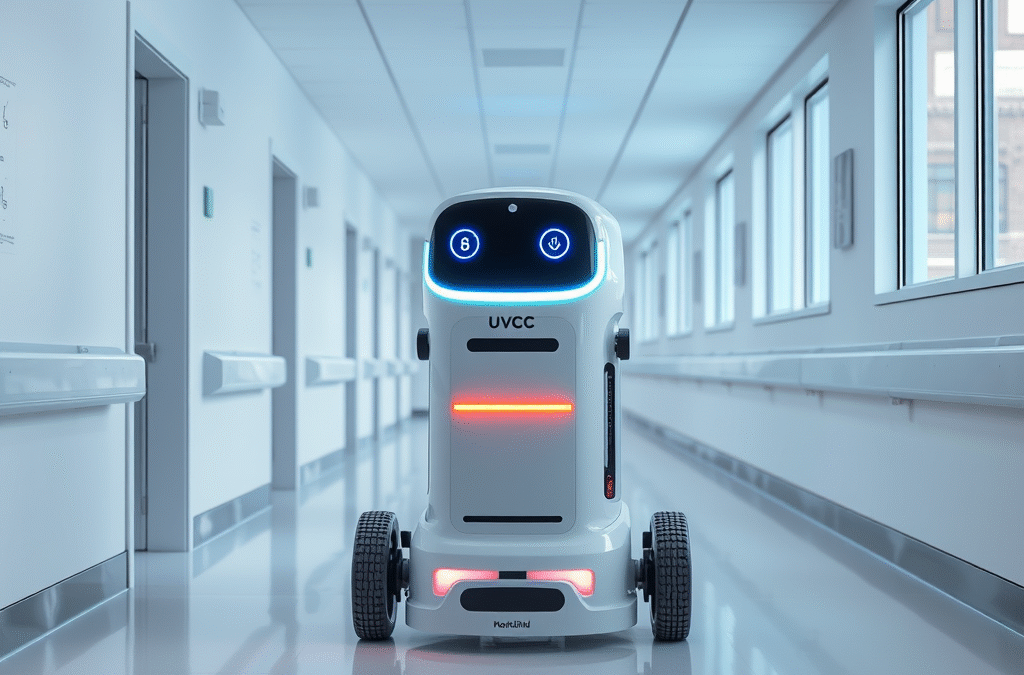
UVC Disinfection Robot for Hospitals: Transforming Hospital Hygiene in 2026
UVC disinfection robots use ultraviolet light to kill germs on surfaces quickly and without chemicals. These robots move through patient rooms, operating rooms, and hallways, shining UV light that destroys bacteria, viruses, and spores. The result is cleaner environments, fewer infections, and less work for cleaning staff. In 2026, hospitals are adopting this technology to improve safety and efficiency.
Introduction to UVC Disinfection Robot for Hospitals
What Is a UVC Disinfection Robot?
- A machine that carries UVC lamps or LEDs.
- It travels automatically or by remote control.
- Emits UV light at a wavelength (254 nm) that breaks the DNA of microbes.
- Leaves no residue, unlike chemical sprays.
How Does It Work Inside a Hospital?
- The robot scans the room with sensors.
- It maps the layout and plans an optimal cleaning path.
- It positions itself and activates the UVC source.
- The UV light penetrates air and surfaces for a set time.
- Sensors confirm that the dose reached the target level.
- The robot logs the cycle and moves to the next area.
- Hospitals face rising infection rates from drug‑resistant bacteria.
- Traditional manual cleaning often misses hard‑to‑reach spots.
- Automation reduces human error and speeds up turnover between patients.
- Regulatory bodies are encouraging evidence‑based disinfection methods.
- Consistency: Every surface receives the same UV dose.
- Speed: A single robot can disinfect a room in 5‑10 minutes.
- Safety: Staff are not exposed to harsh chemicals.
- Data Tracking: Each cycle is recorded for compliance reports.
- Many robots connect to electronic health record (EHR) platforms.
- Facilities managers receive real‑time alerts when a room is ready for the next patient.
- Maintenance schedules are automatically generated based on usage metrics.
- Initial purchase price ranges from $80,000 to $150,000 per unit.
- Ongoing costs include lamp replacement (every 1,000‑2,000 hours) and software updates.
- ROI is often realized within 12‑24 months through reduced infection‑related expenses.
- Patient Rooms: After discharge, to eliminate lingering pathogens.
- Operating Theaters: Between surgeries, to lower surgical site infections.
- Emergency Departments: Quick turnover of high‑traffic areas.
- Isolation Units: Extra protection for contagious diseases.
- Laboratories: Safe decontamination of biosafety cabinets.
- A large urban medical center reported a 30 % drop in Clostridioides difficile cases after adding two UV disinfection robots.
- A children’s hospital used a fleet of portable UV robots to keep pediatric wards ready for new admissions within minutes.
- LiDAR Mapping: Helps robots navigate cluttered spaces.
- AI Path Planning: Optimizes cleaning routes based on room occupancy data.
- IoT Connectivity: Sends status updates to central control dashboards.
- Low‑profile chassis to glide under beds and chairs.
- Adjustable arm or rotating base for even light spread.
- Safety sensors that pause emission if a person enters the room.
- Modular lamp cartridges for quick replacement.
- Fixed‑Dose Mode: Emits a predetermined UV intensity for a set time.
- Adaptive Mode: Monitors room surfaces and adjusts exposure automatically.
- Remote Monitoring: Operators can start, stop, or pause cycles via a tablet.
- Clean the robot’s exterior weekly to prevent dust buildup.
- Perform a calibration check quarterly to ensure accurate dose delivery.
- Update firmware regularly to incorporate security patches.
- Shadow Areas: Curved surfaces can block UV light.
- Material Sensitivity: Some plastics degrade after repeated UV exposure.
- Concerns about job displacement.
- Hospitals must document disinfection protocols for auditors.
- Robots will learn from each cleaning cycle to refine future routes.
- Predictive analytics will forecast high‑risk infection periods and pre‑emptively schedule extra disinfection.
- Cloud‑based platforms will coordinate hundreds of robots across a hospital network from a single dashboard.
- Manufacturing advances and larger production runs will lower the price barrier for smaller facilities.
- Assessment
- Vendor Selection
- Pilot Deployment
- Staff Training
- Integration
- Evaluation
- ☐ Verify robot battery is fully charged.
- ☐ Confirm that the UVC lamp has not exceeded its rated hours.
- ☐ Perform a quick visual inspection for dust or debris.
- ☐ Ensure the room is empty and the safety interlock is active.
- ☐ Start the disinfection cycle and monitor the dashboard.
- ☐ Log the completed cycle in the hospital’s compliance system.
- Turnover Time: Average minutes from patient discharge to room readiness.
- Infection Rate Reduction: Percentage decrease in hospital‑acquired infections.
- Staff Satisfaction: Survey scores on ease of use and perceived safety.
- Operational Cost Savings: Savings from reduced chemical purchases and fewer labor hours.
- Compliance Documentation: Number of audit findings related to disinfection.
Why Is This Technology Gaining Momentum?
Hospital Disinfection Automation: A New Standard
Benefits Over Manual Cleaning
Integration With Hospital Systems
Cost Considerations
UV Robot Healthcare Applications in 2026
Where Are These Robots Deployed?
Real‑World Examples
Supporting Technologies
Key Features of Modern UVC Disinfection Robots for Hospitals
Design Elements
Operational Modes
Maintenance Tips- Schedule lamp replacement after reaching the manufacturer’s hour limit.
Challenges and How to Overcome Them
Technical Limitations
– Solution: Use multiple robots or supplemental handheld wands for corners.
– Solution: Choose UV‑stable equipment and limit exposure time.
Staff Acceptance
– Solution: Position robots as assistants that handle repetitive tasks, letting staff focus on patient care.
Regulatory Hurdles
– Solution: Use built‑in logging features to generate compliance reports automatically.
Future Trends: What to Expect in the Next Few Years### Smarter AI Integration
Multi‑Spectral Disinfection- Combining UVC with visible light or infrared to target a broader range of pathogens.
Scalable Fleet Management
Cost Reduction
Practical Guide: Getting Started With a UVC Disinfection Robot in Your Hospital
Step‑by‑Step Implementation Plan
– Identify high‑traffic zones that need rapid turnover.
– Determine infection rates and current cleaning protocols.
– Compare specifications, warranty terms, and support options.
– Request a trial period to evaluate performance in your environment.
– Start with one or two units in a single ward.
– Collect data on cycle time, coverage, and staff feedback.
– Conduct hands‑on workshops covering operation, safety, and troubleshooting.
– Create easy‑to‑follow checklists for post‑cycle verification.
– Connect the robot’s software to your hospital’s scheduling system.
– Set up automated alerts for completed disinfection cycles.
– Measure infection rates before and after implementation.
– Review cost‑savings and adjust deployment strategy accordingly.
Checklist for Daily Use
Measuring Success: Key Performance Indicators
Frequently Asked Questions (FAQs)
What is a UVC disinfection robot for hospitals?
A UVC disinfection robot for hospitals is an autonomous device that emits ultraviolet C light to kill germs on surfaces quickly and without chemicals.
How does hospital disinfection automation improve patient safety?
It provides consistent, thorough cleaning of high‑touch surfaces, reducing the chance of pathogens spreading between patients.
Can a UV robot healthcar system work in emergency rooms?
Yes, UV robot healthcar units are designed for fast turnover of busy emergency areas, disinfecting rooms in minutes between patients.
Do UVC disinfection robots replace cleaning staff?
No, they complement staff by handling repetitive disinfection tasks, allowing staff to focus on patient care and other essential duties.
What safety features prevent UV exposure to people? Built‑in motion sensors pause the UV source if someone enters the room, and the robot only operates when the space is empty.
How long does a typical disinfection cycle take?
Most hospital rooms are fully disinfected in 5 to 10 minutes, depending on room size and required UV dose.
Are there any surfaces that UVC light cannot effectively clean?
Yes, shaded or heavily reflective surfaces may receive insufficient exposure; supplemental manual cleaning may be needed for corners.
What maintenance is required for a UVC disinfection robot?
Regular lamp replacement, battery charging, exterior cleaning, and firmware updates are essential to keep the robot functioning optimally.
How is compliance documented with automated disinfection? Modern robots automatically log each cycle, capturing dose, duration, and room identifier for audit trails.
Can multiple robots operate simultaneously in a large hospital?
Yes, fleet management software coordinates multiple units to work in parallel across different wings or floors.
What is the expected lifespan of a UVC lamp?
Typical UVC lamps last between 1,000 and 2,000 hours of operation before their intensity drops below effective levels.
Do hospitals need special electrical requirements for these robots?
Most units run on standard 120 V or 230 V outlets, but some high‑power models may require dedicated circuits.
Is training required to operate a UVC disinfection robot?
Yes, staff receive hands‑on training covering safety protocols, operation, and troubleshooting.
How does UVC disinfection affect hospital infection control programs?
It adds a reliable, data‑driven layer that strengthens overall infection control strategies and can reduce reliance on chemical disinfectants.
What should I look for when choosing a vendor?
Look for clear warranty terms, responsive technical support, integration capabilities, and real‑world case studies.
Can the system be used for disinfecting medical equipment?
Some robots are equipped with portable wands or attachments designed to treat small equipment, but most are intended for room surfaces.
Will UVC disinfection damage hospital fixtures or furnishings?
Prolonged exposure can degrade certain plastics; however, typical usage durations are calibrated to avoid material damage.